Posts

Showing posts with the label sociolinguistics

Tech Giant VS Junk Pirate - An Example of the Evocative Potential of Labels in News Headlines

News media seems to have made it a standard to identify someone according to profession, or some other social label, even when irrelevant to the respective story. One example of this is seen in reports about Eric Lundgren; headlines seemingly label their stories as coverage of a legal battle between an “e-waste recycler” and tech giant Microsoft. Many headlines resemble these: Electronics-recycling innovator is going to prison for trying to extend computers’ lives [ LA Times ] ‘E-waste’ recycling innovator faces prison after losing fight with Microsoft [ Seattle Times ] E-waste Innovator Will Go to Jail for Making Windows Restore Disks That Only Worked with Valid Licenses [ Gizmodo ] E-waste Recycler gets 15-months in Prison Thanks to Microsoft [ Legit Reviews ] From these headlines, one could infer the subjective opinions of the writers: This humble “e-waste recycler”, however innovative, is jail-bound because of Microsoft, and likely for some unfair reason. Many of the headlin...
The Fired "Rude" Waiter Was Not "Just French"

Image
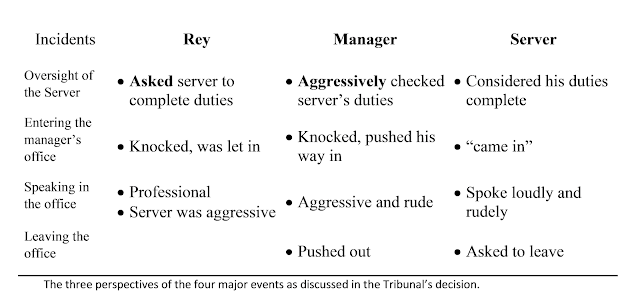
Stereotypes form harmful boxes for containing entire peoples, but some can establish a chicken-and-egg relationship when paired with observation bias. The waiters of Paris have a peculiar stereotype that is as flattering as it is problematic: Apparently, Parisian waiters perform seriously and with pride; so much so that this sense of authority translates as disrespect to the uninitiated. This stereotype has proven so pervasively true that it has inspired a corrective campaign by the Parisian board of tourism and chamber of commerce , as well as a psychological condition wherein Japanese tourists suffer culture shock when confronted by rude Parisians . The stereotype of a haughty French waiter collides with another stereotype in the case of Guillaume Rey, a Paris-trained waiter who was fired from a Toronto restaurant for rude behavior: The overly-serious French waiter was fired for clashing with overly-polite Canadian coworkers. Rey claims that his termination in August 2017 was base...

How to Invent a Method of Forensic Linguistic Analysis

As I've mentioned before , I am writing my master's thesis on a method of linguistic demographic profiling through analysis of native language transference... a specific method that I am in the process of inventing. Not from whole cloth, of course. The potential method I have developed is an amalgamation of established forensic linguistic techniques and contemporary research in machine-based language processing and computational linguistic analysis. I am calling this method "Native Language Analysis," as my advisor suggested. (I wanted to call it native language  deduction  for the Holmesian connotations, but she said no.) I am designing this proposed method of linguistic demographic profiling specifically for native language diagnosis and supporting it with quantified statistical data. Without getting too deep into sociolinguistic philosophy, the concept central to my research is that - like spoken accents - native speakers of a particular language frequently produ...

Crossed in Translation

Cross-linguistic transfer, native language interference, and interlanguage errors are some of the terms for referring to the concept that users of particular languages have characteristic production patterns when using a second language. Cross-linguistic Influence (CLI) refers to the concept that language learners will rely on experience from their L1 to compensate for weaknesses in their target language. All native language analyses rely on the theories central to CLI: That a person’s L1 is their strongest and so they will rely on that language’s structure to compensate for weaknesses in their L2. When the L1 and L2 have different language structures, the resulting language may contain cross-linguistic transfers. To use a metaphor: Those cross-linguistic transfers are as if a target language’s skin is stretched over the native language’s skeleton. The message may still be understood, but the delivery is unnaturally forced; the degree of unnatural depending on the differences of skin...

Not Wrong, Just Not Standard!

Image
There are two types of people: descriptivists and prescriptivists. Especially when it comes to grammar. Most linguists are descriptivists. Your high school grammar teacher was a prescriptivist. A linguistic prescriptivist believes that language use works on a scale of "correct" to "incorrect" based on adherence to a prescribed set of rules. A linguistic descriptivist believes that language users are the writers of those rules, and they are satisfied to describe  the rules those users seem to agree on. I'm going to describe and compare descriptivism and prescriptivism, and it might sound like they're opposing philosophies... but I can't promise that they aren't. In linguistics, the variety of language that most frequently adheres to that language's prescribed rules is called the "standard language." Which variety gets to be the standard depends on each language, country, culture, history, colonialism, and so on. A standard language i...