Posts

Showing posts with the label thesis

Final Thesis Thoughts

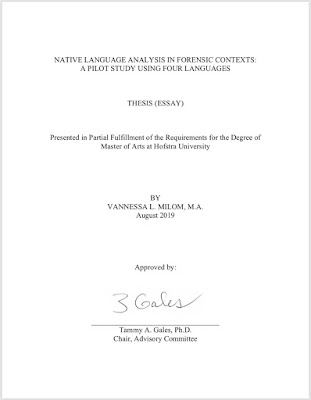
As of today, my complete thesis has been uploaded to the Hofstra library. Unfortunately, as is the modern tradition in academia, most published knowledge is intentionally locked behind a paywall, and my thesis is no exception. All 73 pages of my thesis have been uploaded through ProQuest. Those with institutional or subscription access to that database may download and read it (possibly even in full) through  ProQuest . As a graduate, however, I cannot even access my own paper this way. However, if anyone desires a copy of my thesis in full, I have uploaded a copy to Researchgate: available here . I am still in the process of editing my thesis for publication in academic journals, likely in two or three parts. I also edit and publish large parts of it on this very blog.
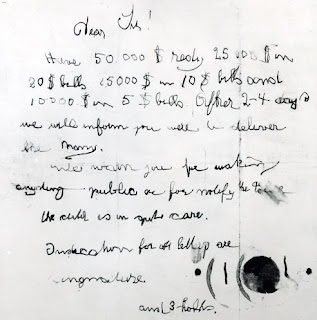
Native Language Analysis for German Transference Features in the Lindbergh Kidnapping Notes

Image
The Nursery Note One of the most famous kidnapping cases in American history is that of Charles Lindbergh, Jr. The child’s father and namesake was Charles Lindbergh, the famous aviator. Lindbergh, Sr. had completed his record-breaking transatlantic flight in 1927, and he was still a prominent celebrity when his 20-month-old son was kidnapped from his nursery on the night of March 1, 1932. The infant was not recovered until May 12, 1932, when his body was discovered near the Lindbergh home. Investigators determined that he likely died shortly after he was taken.  Between the night of March 1 and when ransom is delivered on April 2, 1932, the abductors delivered a total of 15 notes . In September 1934, a German immigrant was seen spending one of the gold certificates used to pay the ransom and was soon arrested. He was convicted and executed in 1936.  Mark Falzini , the archivist of the New Jersey State Police Museum in possession of the notes and other evidence, i...

(Almost) Final Thesis Thoughts

Image
Finally, I have finished my thesis. The drafting and editing is done. It's been approved and is now on its way to the Hofstra library archive. It may be a while, but once it is online, I will share a link to access it. In the meantime, I am incredibly happy and relieved to be finished. To publish my thesis in journals, I believe I have to break it up into smaller articles first. Those will resemble the segments I publish on this blog. There is still work to be done. But now, there is nothing between my degree and a career as a forensic linguist. If I sound dramatic, it's because I have spent over two years working on this research and just about fifteen months writing it. Of course, I'm not done learning, studying, or writing. I will do those until I die.

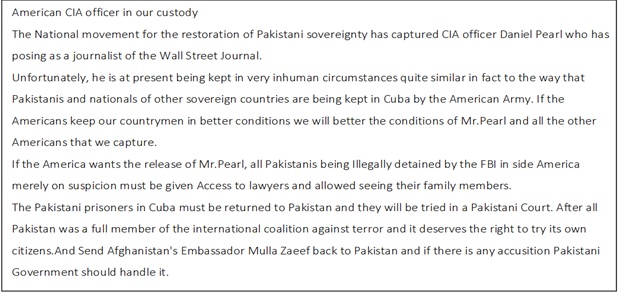
Native Language Analysis for Arabic Transference Features in the Daniel Pearl Abduction Emails

Image
In my thesis, I hypothesize that forensic linguistic techniques of linguistic demographic profiling can be honed into a method of native language analysis that is supported by quantified language transference data. My previous post explains how I set out to develop Native Language Analysis (NLA) as just such a method, and I strongly suggest you read it first. To summarize, I am essentially expanding on the established techniques of author profiling by incorporating quantified language data to connect interlanguage transference features to the native languages that likely inspired them. As promised, this post is based on the sections of my thesis where I test my hypothetical method by using it to analyze the language evidence from real forensic linguistic cases. One of the languages I catalogued data for was Arabic. The evidence I analyzed comes from the case of Daniel Pearl's abduction. Text of Email 1 Daniel Pearl was a journalist for The Wall Street Journal on assignment...

How to Invent a Method of Forensic Linguistic Analysis

As I've mentioned before , I am writing my master's thesis on a method of linguistic demographic profiling through analysis of native language transference... a specific method that I am in the process of inventing. Not from whole cloth, of course. The potential method I have developed is an amalgamation of established forensic linguistic techniques and contemporary research in machine-based language processing and computational linguistic analysis. I am calling this method "Native Language Analysis," as my advisor suggested. (I wanted to call it native language  deduction  for the Holmesian connotations, but she said no.) I am designing this proposed method of linguistic demographic profiling specifically for native language diagnosis and supporting it with quantified statistical data. Without getting too deep into sociolinguistic philosophy, the concept central to my research is that - like spoken accents - native speakers of a particular language frequently produ...

More Thesis Thoughts

Earlier this week, my thesis fell apart when I discovered a research paper that was about my same topic, and it was done so much better than mine. The researcher even used the same corpus! Regardless of how it ruined my life for a minute, Dr. Penny MacDonald's research  was well-done and illuminating on several great points that I will cite in my final draft. After panicking for a whole day and talking to my advisor, it's clear that my mistake was in proceeding too close to computational linguistics, which I know practically nothing about. I will still write my research about Native Language Identification, essentially, but most work in the topic has been computational. So I've got to take a different approach. Most of the NLID studies use large  corpora of second language-English use and then run algorithms or use machine learning to identify the statistically significant language features that might indicate the authors' first language. These studies are so ...

Thesis Thoughts

This is my "thesis semester." Honestly, it's intimidating. A lot of my future hangs on the success of my thesis. If I finish a good seventy pages or so, I can graduate with my MA in Forensic Linguistics. If it is particularly successful, I could publish it and break into the field quite a bit. The topic of my thesis is Native Language Identification as a tool in suspect profiling. Some research on Native Language Identification (NLID) has already been conducted. That research supports the theory that one can deduce a person's first language based on the kinds of "mistakes" they make in their second language. My thesis is about the applications of NLID toward building suspect profiles. Ultimately, my goal is to expand on research in Native Language Identification so that it is more reliably used in cases to implicate or exonerate appropriate suspects. This would have considerable value in cases of terrorist communications and many types of international c...